The history of human endeavor is punctuated by moments that fundamentally alter the trajectory of our species. Among these, few achievements resonate as deeply as the mastery of the skies. For centuries, the dream of flight was tethered to mythology, sketches, and failed experiments. It was not until the early 20th century that the barrier between earth and air was finally breached. The success of the first powered, controlled, and sustained flight did not just represent a mechanical triumph. It signaled the birth of a new era that would shrink the globe. And change the way we perceive distance, commerce, and war.
The Quest for Altitude: A History of Ambition
Before the Wright brothers made history at Kitty Hawk in 1903. The road to aviation was paved with the debris of countless inventors. Pioneers like Sir George Cayley, who identified the four forces of flight—lift, weight, thrust. And drag—and Otto Lilienthal, the “Glider King,” laid the foundational physics that made powered flight a mathematical possibility.
The struggle was not merely about building a machine that could leave the ground. It was about the complex challenge of control. Many early attempts resulted in what engineers called “hop-flight”—brief, uncontrolled leaps that were as dangerous as they were unproductive. The true achievement of the first successful flight lay in the development of a system that allowed the pilot to steer, balance. And maintain altitude, transforming a death-defying jump into a deliberate act of navigation.
The Miracle at Kitty Hawk
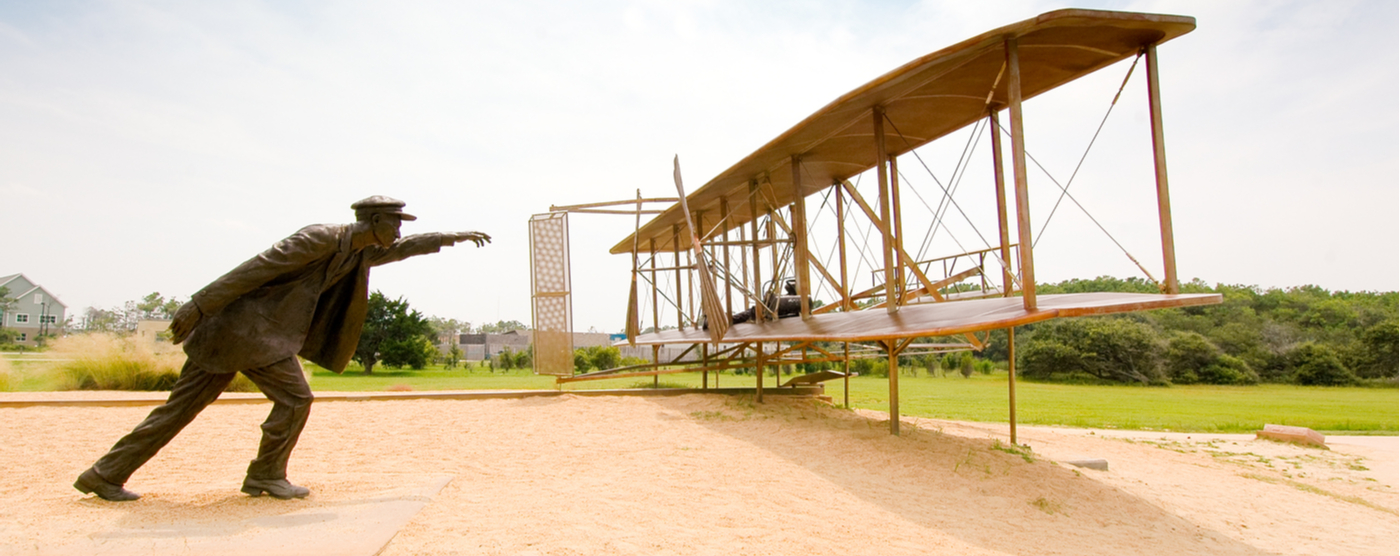
On the morning of December 17, 1903, the Wright brothers, Orville and Wilbur, stood on the dunes of North Carolina. Their machine, the Wright Flyer, was a marvel of aeronautical engineering, constructed from spruce wood, muslin fabric, and a custom-built engine.
When the Flyer lifted off, it traveled only 120 feet and remained airborne for a mere 12 seconds. To the casual observer of today, accustomed to jumbo jets and supersonic travel, these figures seem trivial. However, those 12 seconds represented the culmination of years of rigorous scientific testing in wind tunnels and iterative design. By solving the problem of three-axis control—roll, pitch, and yaw—the brothers had unlocked the secret of sustained flight. They had proven that a heavier-than-air craft could be directed through the air, effectively conquering the primary challenge that had defeated their predecessors.
Engineering Innovation and the Power of Iteration
The success of the first flight was not a stroke of pure luck; it was a victory of the engineering method. The Wright brothers utilized a methodical, analytical approach. They realized that previous aviation enthusiasts had focused too heavily on engine power while neglecting the essential aerodynamics of wings and control surfaces.
By conducting their own experiments and ignoring the flawed data provided by previous aviation “experts,” they built a proprietary wing design and a primitive but effective propeller system. This emphasis on data-driven design—testing, failing, analyzing, and refining—became the blueprint for the entire aerospace industry. Every modern aircraft in the sky today, from commercial airliners to sophisticated space probes, owes its existence to this iterative, disciplined approach to solving complex mechanical problems.
Transforming the World: The Ripple Effects of Aviation
The success of that first flight in 1903 initiated a rapid evolution. Within just a few decades, humanity moved from short hops over coastal dunes to transcontinental crossings. The impact on civilization was immediate and profound.
The aviation industry accelerated global trade, allowing goods to reach distant markets in hours rather than weeks. It transformed geopolitics, as the ability to project power from the air changed the nature of military strategy forever. Perhaps most importantly, it fundamentally shifted the human experience. Travel, once a laborious endeavor reserved for the elite or the incredibly patient, became accessible. The world grew smaller, allowing for an unprecedented exchange of cultures, ideas, and perspectives. We became a global community, connected by a network of aerial bridges that had once been considered physically impossible.
Lessons from the First Flight
Reflecting on the success of the first powered flight offers timeless lessons for modern innovators. The most prominent is the power of persistence in the face of skepticism. During their era, the idea of human flight was often mocked by the public and ignored by the scientific community. The brothers worked in relative obscurity, financed by their own bicycle shop business, driven by a personal commitment to solving a problem that the world deemed futile.
Furthermore, it reminds us that monumental shifts often start with humble, seemingly insignificant steps. That 12-second flight did not change the world overnight, but it opened the door for others to step through. It encouraged the next generation of engineers, pilots, and dreamers to push the boundaries of what was known, leading to the development of commercial aviation, space exploration, and eventually, the digital age that connects us today.
Conclusion: The Legacy of Looking Up
The success of the first powered flight was a watershed moment that defined the spirit of the 20th century. It served as a potent reminder that through human ingenuity, empirical research, and a refusal to accept the limitations of the present, we can overcome the most daunting physical constraints.
As we look toward the future—contemplating electric aviation, autonomous drones, and the eventual colonization of other planets—we are still building upon the foundation laid at Kitty Hawk. That first successful lift-off continues to inspire, teaching us that the only true boundary to our progress is the reach of our imagination. Aviation remains a testament to the fact that when we commit to the hard work of innovation, the sky is not a limit, but merely a beginning.
Would you like me to research and provide a summary of the most pivotal breakthroughs in aviation history that happened in the decades immediately following the Wright brothers’ success?
